
Manual vs Automatic DPD Regeneration


Written by:
LEGEND METAL
Legend Metal is a Japan-based recycling company specializing in the purchasing, analysis, and recovery of catalytic converters, precious metals, automotive components, batteries, and electronic scrap. Since 2014, the company has been delivering accurate valuations, transparent service, and reliable support to clients across Japan and internationally.
Manual and automatic regeneration both remove soot from a diesel particulate filter, but they do so under different operating conditions. A truck DPD will usually try to regenerate without driver input while the vehicle is running. Manual regeneration is a parked process used when normal driving has not cleared the soot load. Knowing the difference helps drivers avoid lost time, excess fuel use, and filter damage. It also helps fleet teams spot deeper faults before a warning light turns into an expensive breakdown.
Key Takeaways
Automatic regeneration takes place during normal vehicle use when set conditions are met.
Manual regeneration is usually a parked process started by the driver or a technician.
Low-speed work and long idling periods can prevent a complete automatic cycle.
A manual cycle should not be started near fuel, dry grass, or other heat-sensitive material.
The time and frequency of regeneration vary by vehicle, duty cycle, soot load, and filter condition.
Repeated requests for manual regeneration can point to an engine, sensor, fuel, or exhaust fault.
What is DPD regeneration?
DPD regeneration is the process of raising exhaust temperature so that trapped soot can burn and leave the filter. The aim is to restore exhaust flow while keeping particulate emissions under control.
DPD often refers to a diesel particulate diffuser, while DPF means diesel particulate filter. Manufacturers may use different labels, but both terms commonly describe a filter within a diesel exhaust aftertreatment system. Always follow the wording and instructions in the vehicle handbook.
The filter catches soot produced during diesel combustion. That soot must be removed from time to time. Regeneration converts much of it into gas and a smaller amount of residue. Ash from engine oil and normal wear does not burn away, so a filter may still need professional cleaning or replacement later in its life.
According to the US Environmental Protection Agency, proper diesel particulate filter operation depends on suitable exhaust temperature, correct maintenance, and attention to warning indicators. Regeneration is therefore part of a wider maintenance process, not a cure for every filter problem.
What is automatic regeneration?
Automatic DPD regeneration begins when the vehicle control system detects a need to reduce soot and the required operating conditions are present. The driver will not normally need to press a regeneration switch.
What happens during an automatic cycle?
The engine control system increases exhaust heat so trapped soot can burn. Depending on the vehicle, this may happen during normal road use with little change in how the truck feels.
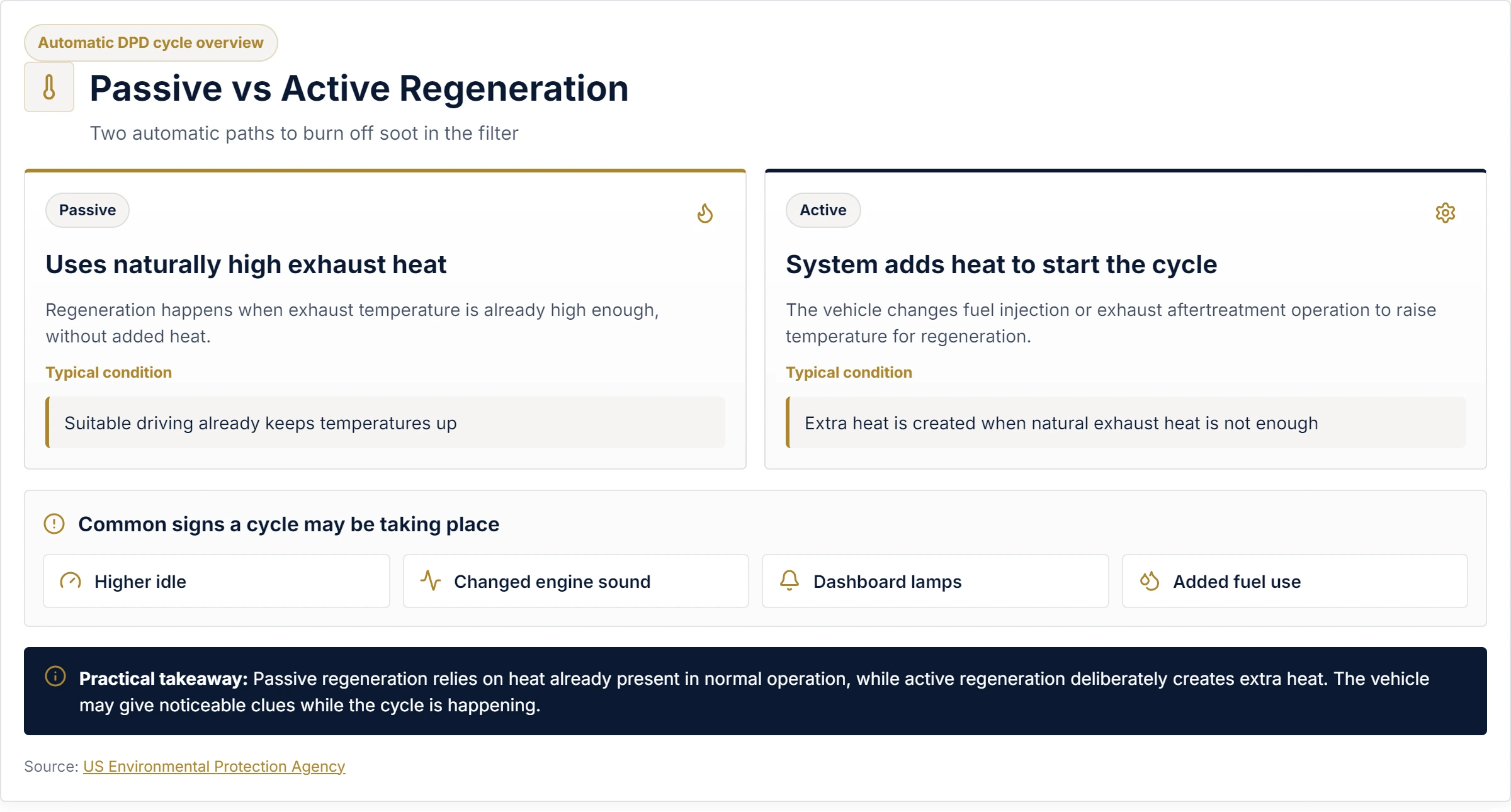
Drivers should avoid switching off the engine when a clear regeneration indicator is active, unless safety or operating rules require a shutdown. Ending cycles early may leave soot in the filter. If that pattern continues, the system may later ask for a parked cycle.
When can automatic regeneration occur?
It can occur when soot load, engine temperature, vehicle speed, and other control values meet the maker's set limits. Steady driving at a suitable engine load often gives the system more opportunity to finish.
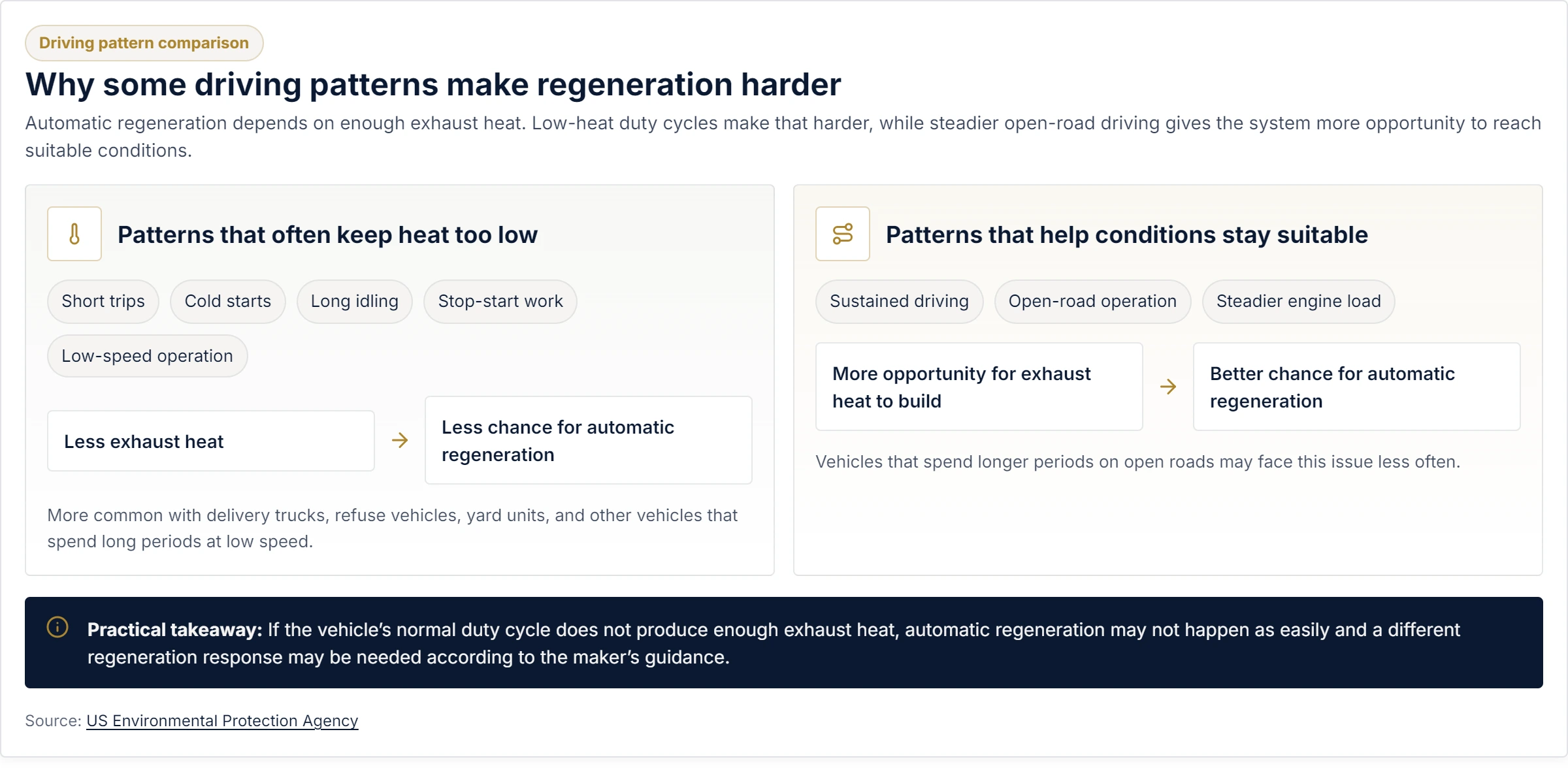
The exact conditions differ by engine and model. A driver should not try to create heat by speeding, holding unsafe engine revs, or ignoring site rules. The correct response comes from the handbook or the fleet's service procedure.
How often should an automatic cycle happen?
There is no single schedule for every commercial vehicle. Automatic DPD regeneration frequency depends on duty cycle, fuel burn, engine health, filter loading, ambient conditions, and whether earlier cycles reached completion.
A stable pattern matters more than a universal number. For example, one truck may regenerate often because it spends each day in slow urban traffic. Another may regenerate less often because sustained driving keeps exhaust temperature high.
Fleet records can reveal changes. If the same vehicle suddenly begins regenerating much more often, check recent routes, idle hours, fault codes, maintenance history, and fuel use. A sharp change should not be dismissed as normal without review.
What is manual regeneration?
Manual DPD regeneration is a driver-started or technician-started cycle, usually completed while the vehicle is parked. It is commonly needed when soot has built up and an automatic cycle could not start or finish.
The dashboard may show a filter lamp or a message that calls for parked regeneration. The correct response depends on the warning level. Some alerts allow the driver to complete a cycle at a safe location. More serious warnings may require workshop diagnosis rather than another attempt.
What conditions must be met before starting it?
The truck must be in a safe state that meets the manufacturer's instructions. Common requirements include a stationary vehicle, an applied parking brake, a suitable transmission position, and no active condition that blocks regeneration.
Before pressing the switch, move the vehicle away from fuel, paper, dry plants, low structures, people, and other heat-sensitive items. The exhaust can become very hot. Do not begin the process inside an enclosed building unless the site has equipment and procedures made for that task.
Check the dashboard first. Confirm that the warning calls for manual regeneration and that no stop-engine warning is present. If the cycle will not begin, do not keep pressing the switch. A safety interlock, fault code, unsuitable temperature, low fuel level, or other system condition may be blocking it.
How do manual and automatic regeneration compare?
Automatic regeneration is designed to fit normal vehicle use, while manual regeneration needs a safe stop and direct action. The table shows the main operating differences.
Point | Automatic regeneration | Manual regeneration |
|---|---|---|
How it starts | The control system starts it when set conditions are met | The driver or technician starts it after a warning or service check |
Vehicle state | Often takes place while driving | Usually takes place while parked |
Driver input | Little or no input under normal conditions | Requires checks and use of the regeneration control |
Main purpose | Controls soot during regular operation | Clears soot when a normal cycle has not completed |
Work impact | Usually low if the cycle finishes during a route | Creates planned or unplanned stationary time |
Failure meaning | Operating conditions or a fault may have blocked the cycle | A failed attempt may require diagnostic work |
How long does parked regeneration take?
There is no fixed manual DPD regeneration time for all trucks. The cycle length depends on soot load, engine design, exhaust temperature, software strategy, and whether the system completes without a fault.
Operators should allow enough time for the full process shown in the handbook. Do not assume that a short rise in engine speed means the cycle has finished. Watch the dashboard and wait for the stated completion signal.
If the engine returns to normal idle early, check whether the warning has cleared. A cycle that ends too soon may have been cancelled. Record the warning lamps, displayed message, engine state, and any conditions that changed during the attempt. These details can help a technician find the cause.
Why does automatic regeneration fail?
It usually fails because the system cannot reach or hold the conditions needed to burn soot. Driving pattern is a common cause, but engine and exhaust faults can also prevent completion.
Can low-speed operation interrupt the process?
Yes. Low engine load, short trips, repeated stops, and long idle periods may keep exhaust temperature below the required range.
A route change may solve an operating-condition issue if the maker allows a suitable driving cycle. However, driving longer will not repair a bad sensor, air leak, injector fault, or heavily restricted filter. If a warning remains after the approved procedure, arrange a diagnostic check.
Can a fault stop regeneration from starting?
Yes. The engine control unit may block regeneration when it detects a condition that could make the process unsafe or ineffective.
Possible areas for inspection include temperature sensing, pressure sensing, fuel delivery, air intake, exhaust leaks, oil level, coolant temperature, and aftertreatment controls. The list is not the same for every vehicle, so fault codes and maker service data should guide the test.
The California Air Resources Board advises drivers to respond to filter warning lamps and maintain the engine and emissions system as required. Ignoring warnings can allow soot loading to rise until normal regeneration is no longer available.
What do common warning signs mean?
Warning signs tell the operator whether to keep driving, perform a parked cycle, or stop and seek service. Exact lamp colors and symbols vary, so the vehicle handbook remains the main guide.
Warning or event | Possible meaning | Practical response |
|---|---|---|
Regeneration indicator appears during driving | An automatic cycle may be active | Keep operating normally when safe and permitted |
Filter lamp requests regeneration | Soot load has reached a level that needs action | Follow the approved driving or parked procedure |
Manual cycle will not start | A start condition is not met or a fault is active | Check the handbook, vehicle state, and fault display |
Cycle stops before completion | A condition changed or the control unit cancelled it | Record the event and avoid repeated blind attempts |
Warning returns soon after completion | Soot production, sensing, cleaning, or filter condition may need review | Arrange diagnosis and inspect service history |
Stop-engine or severe warning appears | The system may need urgent attention | Follow the maker's shutdown and service instructions |
Why is repeated manual regeneration a concern?
Frequent parked cycles can mean that normal regeneration is not working as intended. They can also show that the engine is producing excess soot or that the filter system is reporting incorrect data.
Manual regeneration is a recovery tool, not a substitute for diagnosis. If drivers must perform it again and again, review the whole vehicle rather than treating each warning as a separate event.
Start with the duty cycle. Compare road speed, idle hours, load, trip length, and recent route changes. Next, review fault codes and service records. Check whether earlier cycles finished and whether the filter has had the required ash cleaning.
Engine faults can raise soot output. Filter pressure or temperature sensor issues may also cause false readings or prevent a cycle. Oil or fuel entering the exhaust can create added risk, so unusual smoke, rising oil level, poor performance, or strong odors need prompt inspection.
How should drivers perform a safe parked cycle?
Drivers should use the vehicle maker's steps and complete the process only in a clear, safe area. A simple check before starting can prevent burns, fire risk, and an aborted cycle.
Read the dashboard message and confirm that parked regeneration is requested.
Move to an open area away from people, fuel, dry grass, walls, and stored goods.
Park on firm ground and set the parking brake.
Place the transmission in the position stated by the manufacturer.
Turn off equipment that the handbook says must not run during regeneration.
Check for severe warnings, leaks, unusual smoke, or other signs that need service.
Start the cycle with the approved control and remain near enough to monitor the truck safely.
Wait for the completion signal before returning the vehicle to work.
Record the date, mileage, warning state, and result in the fleet log.
How can fleet managers reduce regeneration problems?
Fleet managers can reduce problems by matching vehicles to routes, training drivers, tracking regeneration events, and fixing engine faults early. Good records often reveal a pattern before a truck loses power.
What should a regeneration log contain?
A useful log should show when, where, and why each cycle occurred. It should also record whether the cycle finished and how soon the next warning appeared.
Vehicle number, mileage, and engine hours
Date, route type, load, and recent idle time
Dashboard lamp or message shown
Automatic or manual cycle
Start and completion status
Any fault codes or performance changes
Driver comments and workshop action
Review the log by vehicle and route. Several events across one route may point to unsuitable operating conditions. Repeated events on one truck may point to a maintenance need.
When does the filter need cleaning or replacement?
A filter may need off-vehicle cleaning when non-combustible ash restricts it or when the maker's service interval calls for cleaning. Replacement may be needed if the filter is cracked, melted, contaminated, or no longer serviceable.
Regeneration burns soot, but it does not remove all ash. A technician should measure restriction and inspect the unit rather than decide from appearance alone. Poor cleaning methods can damage the filter body or leave residue inside it.
When a used truck DPF reaches the end of its service life, it should enter a responsible collection and recycling route. Keep part numbers, vehicle details, service records, and quantity data where possible. These details support sorting, traceability, and a clearer assessment of the recovered unit.
What is the difference between soot, ash, and filter damage?
Soot can often be burned during regeneration, while ash remains and may require physical cleaning. Filter damage is a separate condition that regeneration cannot repair.
Soot load rises during combustion, especially when the engine works under conditions that produce more particulate matter. Ash builds more slowly from material that does not burn away. A damaged filter may have cracks, melted areas, loose material, or contamination.
This difference explains why repeated regeneration is not always useful. If ash restriction or physical damage is the real cause, more heat will not restore the unit. Accurate inspection prevents wasted time and reduces the risk of further damage.
What should happen to an end-of-life unit?
An end-of-life unit should be identified, stored safely, and sent through a traceable recycling process. It should not be mixed without records or treated as ordinary waste.
Commercial exhaust parts may contain recoverable material. Clear identification helps a recycling specialist assess the unit by part number, manufacturer, model, condition, and other available data. Large commercial vehicle parts also need suitable lifting, storage, and transport due to their size and weight.
Businesses with units at more than one site can review Legend Metal branch information when planning collection or delivery. Good preparation includes separating unit types, retaining labels, noting quantities, and preventing avoidable damage during storage.
Summary
Automatic regeneration manages soot during normal vehicle use when the right conditions are present. Manual regeneration is a parked recovery process used when soot loading needs direct action. Neither process should become a routine answer to recurring warnings.
Drivers should follow dashboard guidance, choose a safe location, and let each approved cycle finish. Fleet teams should track frequency, aborted cycles, fault codes, routes, and filter service history. When a unit cannot be cleaned or returned to service, a specialist recycling service such as Legend Metal can support responsible assessment, collection, and material recovery.